

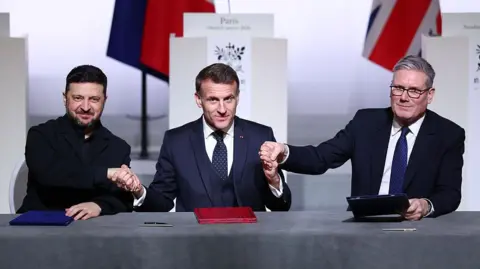
The London and Paris have inked a declaration of intent concerning the deployment of military forces in the nation should a peace deal be struck with Moscow, the Prime Minister of Britain, Sir Keir Starmer, has stated.
Following discussions with Ukraine's allies in Paris, he indicated that the UK and France would "establish defense centers in various parts of Ukraine and build fortified installations for arms and military equipment" to deter any future incursion.
The partner countries also proposed that the US would assume leadership in overseeing a ceasefire.
Moscow has repeatedly warned that any external forces in Ukraine would be considered a "valid objective", but has as yet not responded on this new announcement.
The Situation and Continuing War
Moscow's leader Vladimir Putin launched a major offensive of Ukraine in the start of last year, and Russian forces at this time controls about 20% of Ukraine's sovereign soil.
"This is a vital part of our pledge to stand with Ukraine for the long-term," commented the British leader.
Heads of state and top officials from the "Partner Group" were involved in the Paris negotiations.
Speaking at a combined announcement, he added: "It creates the pathway for the legal framework under which British, French, and partner forces could function on the ground in Ukraine, securing Ukraine's air and maritime domains, and regenerating Ukraine's armed forces for the years ahead."
The UK prime minister went on to say that the UK would participate in any American-headed verification of a possible ceasefire.
Defense Assurances and Negotiation Stances
Top American diplomat Steve Witkoff said that "long-term security guarantees and substantial prosperity commitments are vital to a lasting peace" in Ukraine – mentioning a key demand made by Ukraine.
Witkoff said the partner nations had "substantially agreed on" their work on agreeing such guarantees "in order that the citizens of Ukraine know that when this conflict ends, it ends for good."
Donald Trump's son-in-law, ex-President Donald Trump's advisor, also participated in the talks.
Separately, France's leader Emmanuel Macron said that Ukraine's allies had made "major advances" at the negotiations.
He added that "robust" defense assurances for Ukraine had been settled upon in the instance of a prospective ceasefire.
Ukrainian President Volodymyr Zelensky said that a "huge advance" had been made in the talks, but cautioned that he would only view efforts to be "enough" if they culminated in the end of the fighting.
Earlier, Zelensky suggested a peace deal was "largely prepared". Agreeing on the remaining 10% would "decide the outcome of peace, the destiny of Ukraine and Europe".
Remaining Challenges
- Sovereign soil and defense assurances have been at the center of key disagreements for diplomats.
- Moscow has consistently stated that Kyiv's military must retreat from all of Ukraine's eastern Donbas region or Russia will take control, rejecting any middle ground over how to end the war.
- Kyiv has to date ruled out giving up any land, but has proposed that Ukraine could move its troops to an mutually accepted point – but only if Russia does the same.
Russia currently holds approximately 75% of the Donetsk region and around 99% of the adjacent Luhansk. The pair of oblasts form the industrial region of Donbas.
The initial US-led 28-point peace plan that was circulated to the media last year was perceived by Ukraine and its EU supporters as being disproportionately favorable in Moscow's direction.
This sparked a period of intensive negotiations – with Ukraine, the US and European leaders trying to amend the draft.
The previous month, The Ukrainian government submitted the US an updated framework – as well as distinct documents outlining prospective defense assurances and arrangements for Ukraine's reconstruction, he said.


